The Compliance Playbook for X DM Automation: Staying Within ToS, GDPR, and CAN-SPAM
If you're an agency, an enterprise revenue team, or a startup selling into regulated markets, compliance is the question that determines whether X DM automation is even on the table. It's the question your legal team asks before procurement signs. The question that kills tools in security review. The question competitors avoid because answering it honestly forces them to confront what they shouldn't be doing.
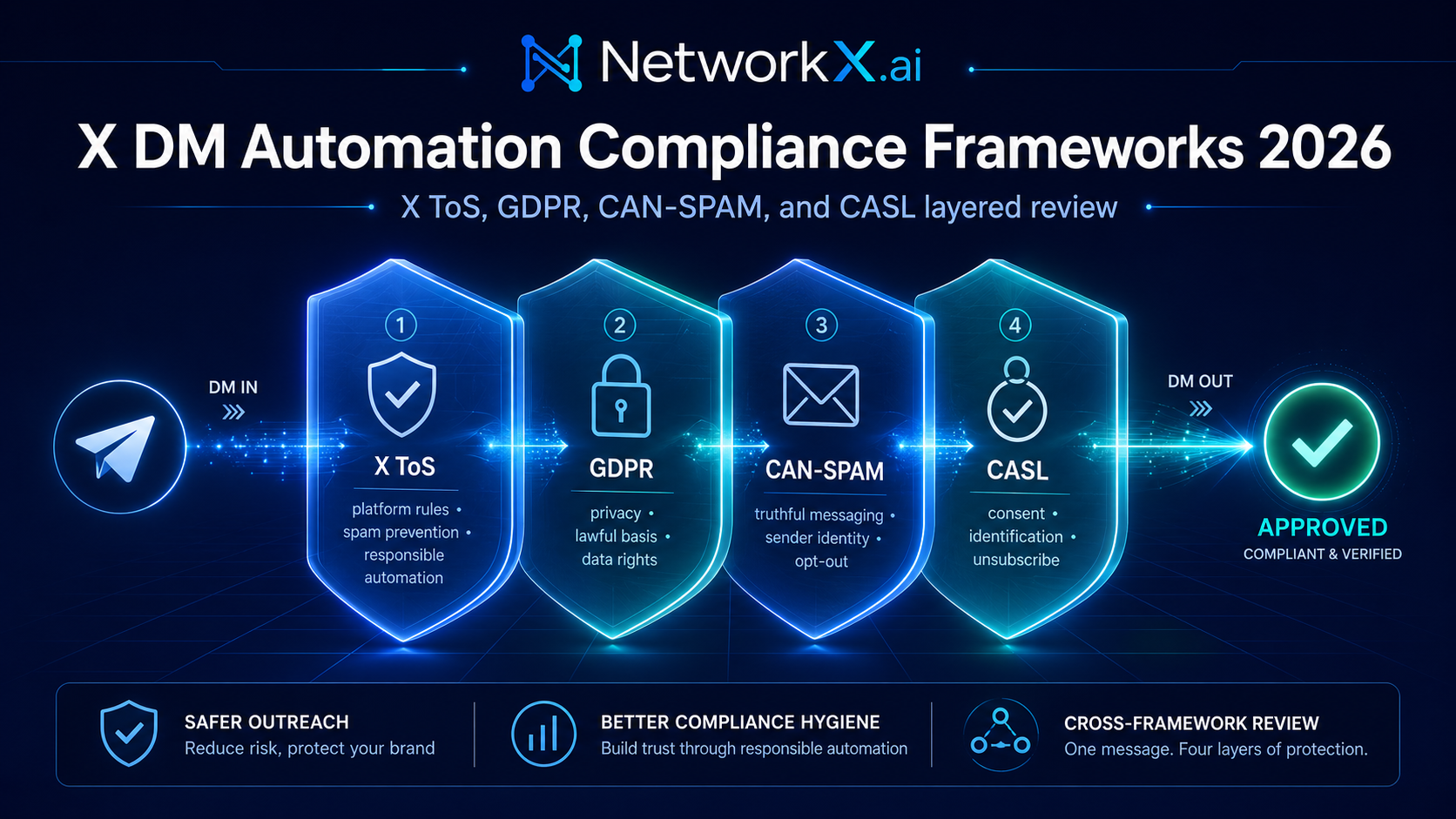
This playbook covers the four frameworks that govern X DM outreach in 2026 — X's own automation policy, GDPR (with the ePrivacy overlay), CAN-SPAM, and CASL — and what each one actually requires for defensible, audit-ready outbound. By the end, you'll have a clear framework for deciding what's allowed, what's prohibited, and what documentation your team needs to produce the moment a regulator, security auditor, or chief compliance officer asks.
TL;DR — The Four Frameworks That Govern X DM Outreach in 2026
X's Developer Policy
— Bulk programmatic cold DMs are explicitly prohibited. "Auto-DM after follow," coordinated multi-account behavior, and DMs without meaningful human participation all violate ToS and trigger account suspension.
GDPR + ePrivacy (EU)
— DMs to identifiable individuals require either consent or a documented Legitimate Interest Assessment (LIA). Country-level ePrivacy rules can override GDPR (Germany strict, France permissive, UK corporate-subscriber exemption). Fines up to
€20M or 4% of global revenue.
CAN-SPAM (US)
— DMs covered as "commercial electronic messages." Opt-out model, but every technical requirement is non-negotiable. Fines:
$53,088 per non-compliant message
; up to
$2M total
in aggravated cases.
CASL (Canada)
— Strictest framework. Express or implied consent required; "conspicuous publication" test for cold outreach. Fines up to
CAD $10M per violation
.
The recurring theme across all four:
no framework outright bans cold X DM outreach. Each carves out a compliant pathway — but each demands documentation. Defensibility comes from the paper trail, not the legal theory.
Why X DM Automation Compliance Is Different From Email
Most B2B compliance content treats email as the universal channel and assumes the same rules apply elsewhere. They don't.
X DM automation sits at the intersection of two distinct regulatory layers that don't perfectly overlap:
Privacy and electronic communications law
— GDPR, CAN-SPAM, CASL, PECR, the Australian Spam Act. These govern
what you can do with personal data and unsolicited commercial messages
, regardless of channel.
Platform terms of service
— X's Developer Policy and Automation Rules. These govern
what you can do specifically on X
, regardless of legal jurisdiction.
A campaign can be fully GDPR-compliant and still violate X's ToS, getting your account suspended. Or fully ToS-compliant and still trigger a CNIL fine. Both layers must be cleared independently. This is where most "compliance playbooks" published by automation tool vendors fall short: they cover one layer and pretend the other doesn't exist.
Layer 1: X's Developer Policy and Automation Rules
X's Automation Rules and Developer Policy are explicit about what's prohibited. The key provisions:
Prohibited
- Bulk or coordinated DMs. Sending identical or substantially similar DMs to many recipients programmatically.
- Auto-DMs triggered by follow. The classic "Thanks for following — check out my product" message that fires automatically.
- Programmatic cold DMs for marketing. X explicitly calls out "any programmatic use of the DM endpoint for marketing purposes" as prohibited.
- Misleading links. Automated DMs containing redirect links, shorteners that obscure destinations, or deceptive landing pages.
- Coordinated multi-account behavior. Posting or DMing identical content from multiple accounts to amplify reach.
Permitted
- Scheduled content publishing through authorized OAuth-connected apps.
- Opt-in DM responses — replies to users who initiated a conversation or explicitly requested contact.
- AI-assisted drafting of posts and messages, as long as a human reviews and sends.
- Reading public data via the API for research, lead intelligence, or signal detection.
The deciding factor
X's enforcement standard is "meaningful human participation." A tool that drafts a personalized message based on a prospect's public activity, surfaces it to you with context, and lets you review and send is on the safe side. A tool that fires DMs while you sleep is not.
The 2026 enforcement environment has tightened this further. X's "human-only interaction" rules — rolled out alongside the February 2026 bot purge — actively flag accounts with no manual activity as high-risk for suspension, even when the activity is technically within published rate limits.
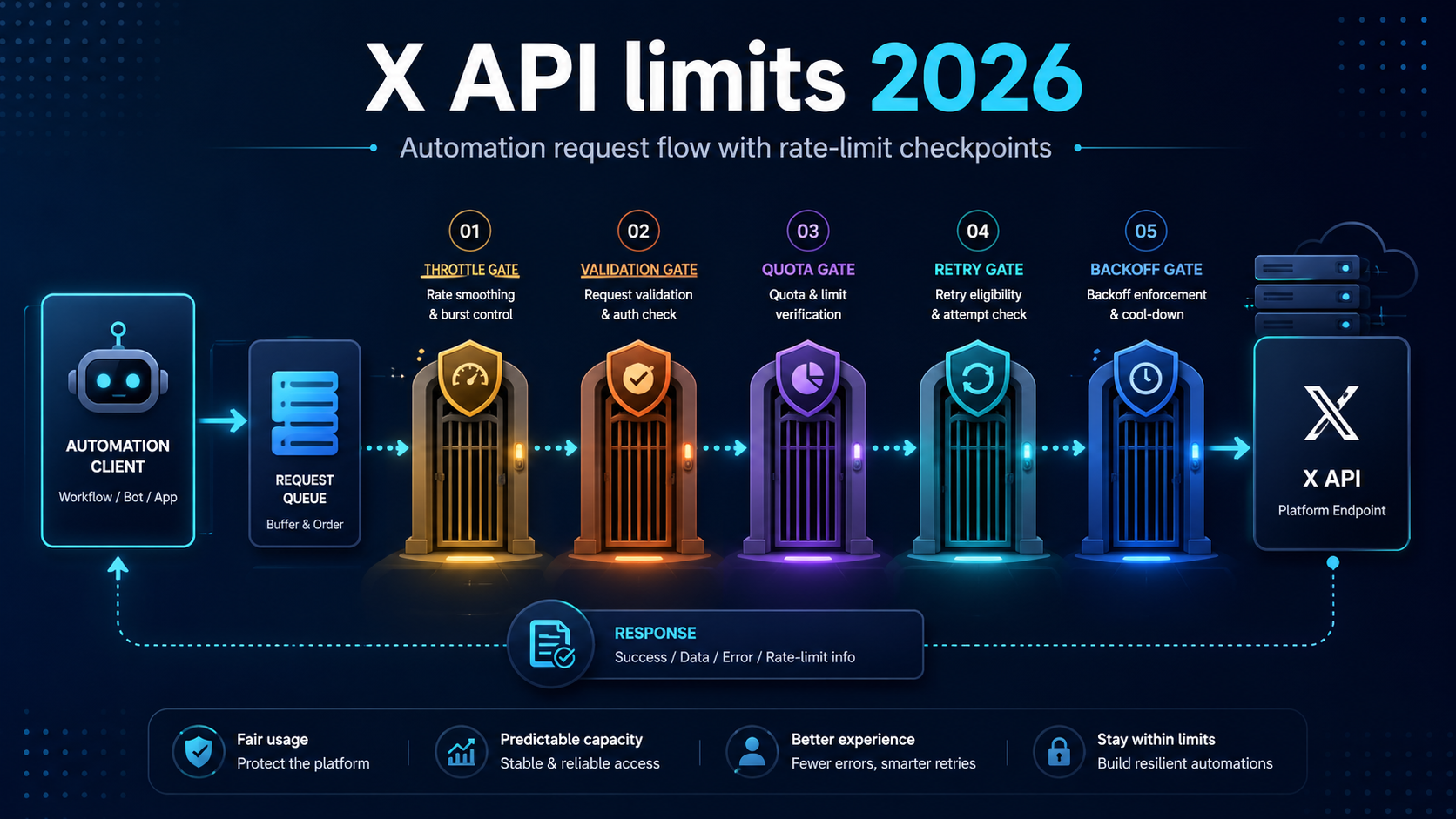
For deeper coverage of the X-specific layer, see X API limits in 2026.
Layer 2: GDPR and the ePrivacy Overlay (EU)
This is where most US-based teams get into trouble — usually because they assume "B2B outreach" exempts them from GDPR. It doesn't.
GDPR applies to X DMs to EU residents
GDPR governs the processing of personal data of individuals located in the EU, regardless of where the sender is based. A DM from a Texas-based SDR to a Berlin-based CTO is a GDPR event. The CTO's name and X handle are personal data under the regulation.
GDPR doesn't ban cold DM outreach. Recital 47 explicitly recognizes direct marketing as potentially constituting a legitimate interest under Article 6(1)(f). What it requires is that you have a documented lawful basis for processing the recipient's personal data.
The Legitimate Interest Assessment (LIA)
For B2B cold outreach, "legitimate interest" is the practical legal basis — but it's not a checkbox. It requires a documented three-part test:
Purpose test.
Identify your legitimate business interest (e.g., direct marketing of relevant B2B products to professionals who may benefit).
Necessity test.
Demonstrate why the DM is necessary to achieve that interest and why no less-intrusive alternative exists.
Balancing test.
Show that your interest does not override the recipient's privacy rights — typically established through relevance to their professional role, minimal data processing, and an easy opt-out.
The LIA must be documented in writing and dated before processing begins. EDPB Guidelines 1/2024 confirm legitimate interest is "not an open door" and that the "compelling legitimate grounds" threshold for overriding objections is high.
The ePrivacy override (where most teams trip)
GDPR alone would make B2B outreach relatively straightforward. The complication is the ePrivacy Directive (2002/58/EC), which sets country-level rules for unsolicited electronic communications and takes precedence over GDPR where the two overlap (Article 95 + Recital 173).
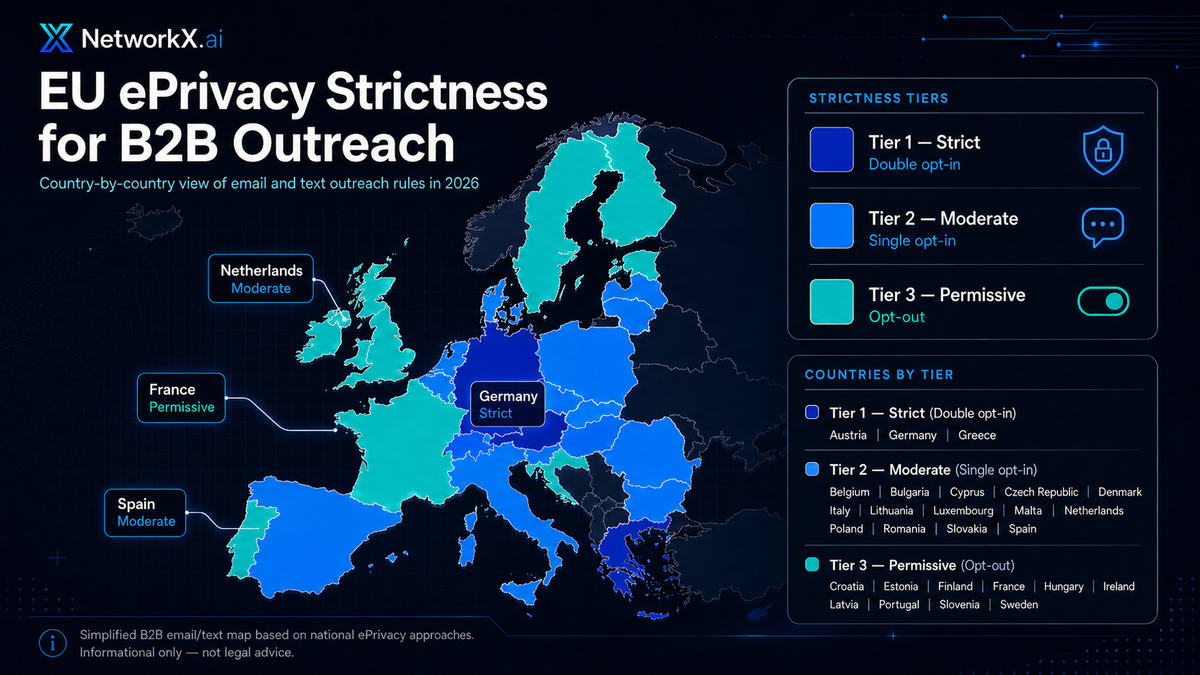
Each EU member state implemented ePrivacy differently:
| Country | B2B Cold Outreach Posture |
|---|---|
| France | Permissive for profession-related outreach to corporate addresses |
| Germany | Strict — UWG §7 commonly enforced as requiring prior consent, even for B2B |
| Netherlands | Permissive for B2B with fewer restrictions |
| UK (post-Brexit) | PECR explicitly exempts corporate subscribers from the consent rule for B2B outreach |
| Spain, Italy, others | Variable — check national ePrivacy transposition before sending |
Practical implication: a campaign that's perfectly compliant in France can violate German law next door. Multi-country campaigns require either (a) per-country compliance workflows or (b) applying the strictest standard universally.
GDPR enforcement: the financial stakes
GDPR fines in 2024–2025 made it clear regulators are paying attention to commercial outreach:
- €20 million or 4% of global annual turnover — maximum penalty
- Cumulative GDPR fines crossed €5.88 billion by January 2025, with ~35% from consent-related violations
- Orange (France): €50 million in December 2024 for weaving ads into transactional emails without consent
- CNIL increased SMB inspections by 300% between 2023 and 2024
- SOLOCAL: €900,000 for commercial prospecting without consent
- Carrefour: €3.05 million for failing to process unsubscribe requests
Most teams won't face a maximum fine. But domain reputation damage, deliverability collapse, and operational disruption from a single bad campaign are real even at smaller penalty levels.
Layer 3: CAN-SPAM (United States)
CAN-SPAM is the most permissive of the major frameworks for B2B cold outreach. It operates on an opt-out model — no prior consent required — but every technical requirement on every message is non-negotiable.
What CAN-SPAM requires for every X DM to a US recipient
Accurate sender identification.
The "From" must correctly identify the sender or business.
Non-deceptive subject lines
(where applicable) and message content.
Identification as a commercial message
when context requires.
A valid physical postal address
(in the message or accessible via the sender's profile).
A clear, functional opt-out mechanism
, honored within 10 business days.
For X DMs specifically, this typically means a brief sender identification line and a clear path to opt out (e.g., "Reply STOP if you'd prefer no further messages") — adapted to the platform's character and format constraints.
CAN-SPAM enforcement: bigger numbers than most teams realize
- $53,088 per non-compliant message (FTC's 2025 inflation-adjusted figure)
- Up to $2 million in aggravated cases
- Verkada (August 2024): $2.95 million — the largest CAN-SPAM penalty in history, paid for failure to honor opt-outs and lack of clear sender identification
The "permissive opt-out model" doesn't mean "anything goes." It means the bar is procedural rather than consent-based. Procedural failures still produce eight-figure exposure.
Layer 4: CASL (Canada)
CASL is the strictest of the four frameworks. It operates on opt-in, not opt-out, and applies to all commercial electronic messages — including DMs — sent to Canadian recipients regardless of the sender's location.
What CASL requires
CASL requires either express consent (documented opt-in) or implied consent before any commercial electronic message. For B2B cold outreach, the practical legal basis is the conspicuous publication test:
The recipient's contact information is publicly posted (company website, professional directory, public X profile)
The publication is not accompanied by a statement declining unsolicited messages
Your message is relevant to the recipient's professional role, functions, or duties
If all three conditions are met, you have implied consent for an initial message — but only an initial message. Implied consent under conspicuous publication is narrower than CAN-SPAM's blanket permission.
Every CEM sent under CASL must include:
- Sender's name and business identification
- Physical mailing address
- Either a phone number, email, or web address
- A functional unsubscribe mechanism, honored within 10 business days
- The unsubscribe mechanism must remain functional for at least 60 days after the message is sent
CASL enforcement
- Up to CAD $10 million per violation for organizations
- Up to CAD $1 million per violation for individuals
- Canada has issued penalties up to CAD $1.1 million for sending without proper consent
For multi-jurisdiction campaigns reaching US, EU, and Canadian recipients, the simplest defensible approach is to apply the strictest standard (CASL) universally.
The Practical Compliance Stack: Documentation Every Team Needs
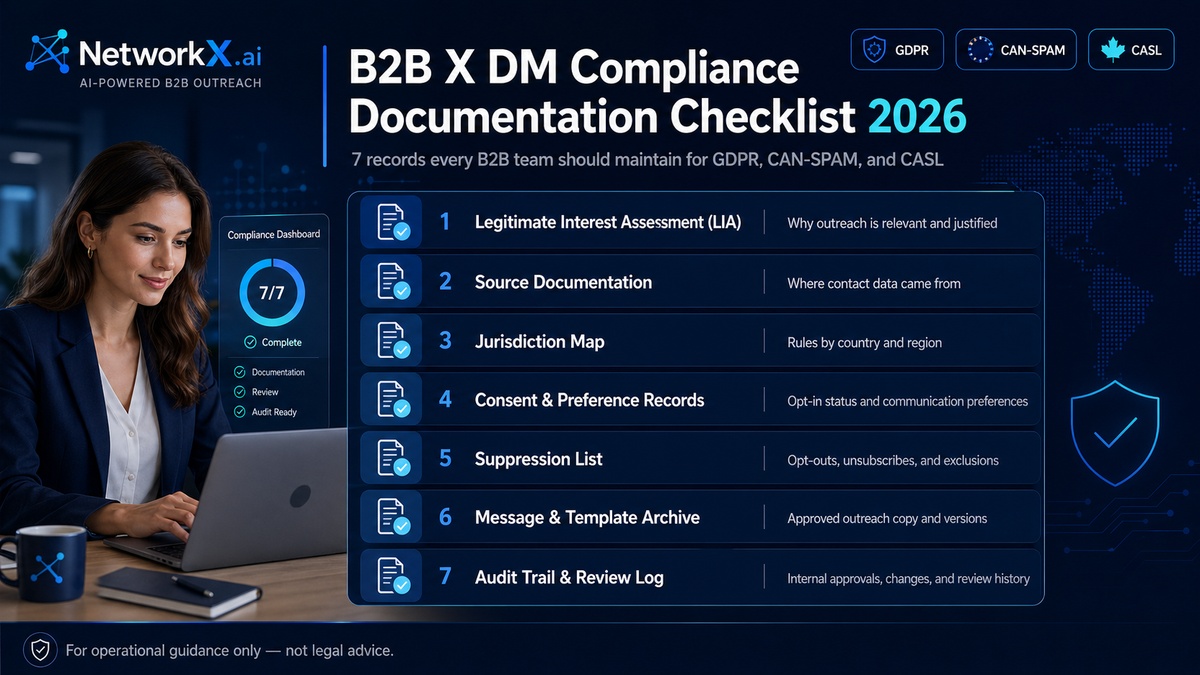
Across all four frameworks, the difference between defensible outreach and expensive violations comes down to documentation. Every B2B team running X DM outreach in 2026 should maintain:
1. A documented Legitimate Interest Assessment (LIA)
One per campaign, not a one-time corporate boilerplate. Each LIA should cover purpose, necessity, balancing test, conclusion. Doesn't need to be a 40-page legal memo — a clear two-page document is sufficient. Must exist before processing begins.
2. Source documentation for every prospect
Where did the contact come from? When? Was their X handle/profile publicly available? Was there a statement declining unsolicited messages on their profile or pinned content? Even a structured spreadsheet with source URL and timestamp per contact satisfies the documentation requirement.
3. A jurisdiction map
Tagged by country: which prospects are in the EU (and which member state), US, Canada, UK, or other markets. This determines which framework applies. Multi-country lists need either workflow segmentation or strictest-standard-applied-universally.
4. Suppression list infrastructure
A real, automated suppression list — not a Slack channel where opt-outs get pasted. Must be queried before every send. Opt-outs honored within the strictest applicable window (CASL: 10 business days; GDPR: best practice 24–48 hours; CAN-SPAM: 10 business days).
5. Sender identification template
Each DM template must contain (or link to) clear sender identification, business identification, physical mailing address, and a functional opt-out path. Adapted to X's format constraints but never omitted.
6. Per-message human review log
For X specifically, demonstrating "meaningful human participation" requires logs showing approval of each message before send. Bulk-approve workflows that rubber-stamp 200 DMs in 30 seconds don't satisfy the standard. Genuine review does.
7. Compliance ownership
Enterprises sending 50,000+ outreach messages monthly should designate a compliance officer. Smaller teams should assign compliance ownership to RevOps or Legal, not bury it in the marketing org.
What This Looks Like in Practice for an X DM Workflow
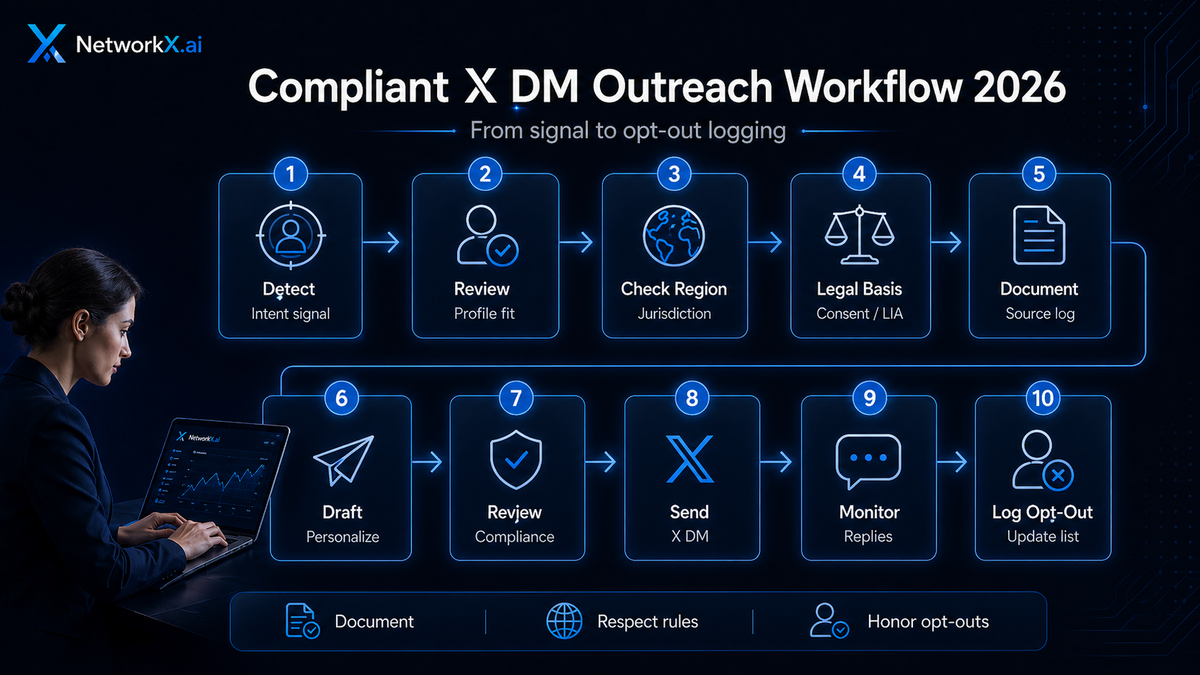
Putting the four layers together, a defensible X DM workflow in 2026 looks like this:
Signal detection from public X activity.
Reading public data is permitted under X's API and triggers minimal personal data processing under GDPR.
Prospect tagging by jurisdiction.
Determine which framework applies before any outreach is drafted.
LIA documented for the campaign
(if EU-targeted).
Conspicuous publication check
for Canadian prospects.
AI-drafted message tied to the public signal.
Personalized, relevant to professional role, includes sender identification, includes opt-out path.
Human approval before send.
Logged. Auditable.
Send through OAuth-connected official app.
Not a scraper. Paced within X's published rate limits.
Suppression list queried before send.
Universal across campaigns.
Opt-outs honored within 24–48 hours.
Logged.
All documentation retained for at least 24 months
(GDPR retention principle: as long as needed for the legitimate interest).
Yes, this is more work than blasting DMs. It's also the difference between a tool that survives enterprise procurement and one that doesn't.
How NetworkX.ai Approaches Compliance
NetworkX.ai is built specifically for the compliance environment described above. The platform:
- Operates as a smart assistant with mandatory human approval before any DM sends — satisfying X's "meaningful human participation" standard
- Connects via OAuth through official X API integration, not scraping
- Surfaces public-data signals rather than relying on purchased or scraped contact lists
- Logs every approval, send, and opt-out for audit-ready documentation
- Supports suppression list management that respects opt-outs across campaigns
- Includes message templating with structured sender identification and opt-out fields
For agencies and enterprise teams, this is the architecture that survives a compliance review. If you're evaluating X DM tools and need to satisfy a security questionnaire, legal review, or DPO, book a consultation — we can walk you through the specific compliance documentation NetworkX.ai produces and how it maps to GDPR, CAN-SPAM, CASL, and X's ToS requirements.
For teams ready to start with a self-serve trial under standard compliance defaults, start a free trial.
Frequently Asked Questions
Is X DM automation legal in 2026?
Yes — but with significant caveats. X explicitly prohibits bulk programmatic cold DMs under its Developer Policy, but permits AI-assisted drafting with human approval, opt-in responses, and DMs paced within the platform's user-level limits. Beyond X's ToS, DMs are subject to GDPR (EU), CAN-SPAM (US), and CASL (Canada). The legal basis for cold B2B DMs in the EU is "legitimate interest" with a documented Legitimate Interest Assessment. In the US, CAN-SPAM's opt-out model applies. In Canada, CASL's "conspicuous publication" test typically governs cold B2B outreach.
Does GDPR ban cold DMs to EU prospects?
No. GDPR Recital 47 explicitly recognizes direct marketing as potentially constituting a legitimate interest under Article 6(1)(f). For B2B cold DMs to identifiable individuals in the EU, the practical legal basis is legitimate interest, which requires a documented three-part Legitimate Interest Assessment (purpose, necessity, balancing test). Country-level ePrivacy rules can override GDPR — Germany requires consent in most B2B contexts, while France and the UK are more permissive for professional outreach.
What are the fines for non-compliant cold DM outreach in 2026?
GDPR: up to €20 million or 4% of global annual revenue. CAN-SPAM: $53,088 per non-compliant message, up to $2 million aggregated in aggravated cases. CASL: up to CAD $10 million per violation for organizations, CAD $1 million for individuals. Beyond regulatory fines, X account suspension, domain reputation damage, and deliverability collapse from a single bad campaign create operational costs that often exceed the fines themselves.
Do I need a Legitimate Interest Assessment for every campaign?
Yes, if you're sending cold DMs to identifiable individuals in the EU. EDPB guidance treats LIA as required documentation for any controller relying on Article 6(1)(f). The LIA does not need to be a 40-page legal memo — a clear two-page document covering purpose, necessity, and balancing tests is sufficient. It must exist in writing before processing begins, not be created retroactively if a regulator inquires.
Is the "B2B exemption" enough to send cold DMs to anyone with a business email or X profile?
No. There is no universal "B2B exemption" across regulatory frameworks. GDPR makes no formal distinction between B2B and B2C. The exemptions that exist (UK PECR's corporate-subscriber rule, ePrivacy variations in some member states) are country-specific and conditional. Sole traders, freelancers, and individual consultants are typically classified as individuals, not businesses, under most frameworks — meaning B2C rules apply even when their context appears B2B.
How does compliance differ for X DMs versus cold email?
The privacy-law layers (GDPR, CAN-SPAM, CASL) apply identically — "commercial electronic message" definitions in all four frameworks cover DMs as well as emails. The platform layer is unique to X: X explicitly prohibits programmatic cold DMs under its Developer Policy, while email has no equivalent platform-level restriction. The combination means X DM automation faces both regulatory and platform-level constraints that email doesn't, requiring tighter human-in-the-loop workflows.